

As the clock ticks away, accounting professionals might feel like they’re standing on thin ice, wondering if the rising tide of artificial intelligence (AI) will eventually sweep them away.
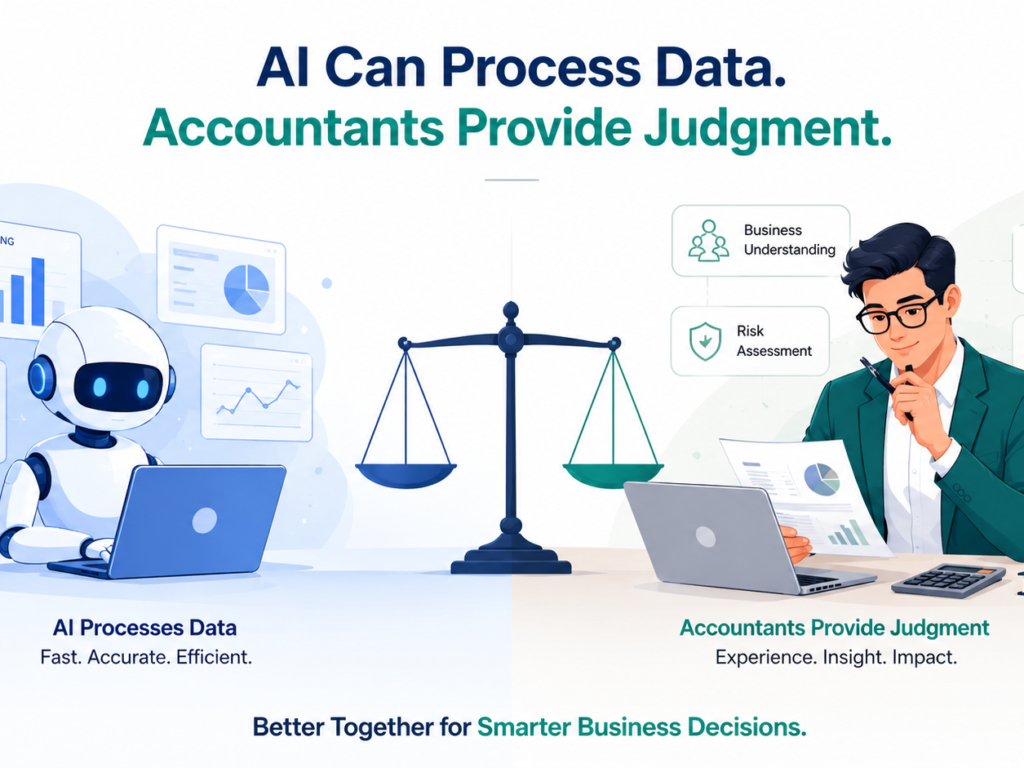
But, just as a master chef uses a sharp knife to enhance their craft, not replace their skills, AI is poised to augment the work of accountants, not supplant them.
The intricate dance of financial regulations, tax laws, and business strategies requires a human touch, a nuance that AI systems, no matter how advanced, currently cannot replicate.
With the complexity of accounting growing exponentially, the need for skilled professionals to navigate this labyrinthine world is more pressing than ever, making it unlikely that AI will replace professional accountants anytime soon.
Limitations of AI in Replacing Human Accountants in Complex Advisory Roles Exist
The role of accountants is evolving with the integration of Artificial Intelligence (AI) in financial processes, but there are limitations to AI’s capabilities in replacing human accountants, especially in complex advisory roles that require expertise, judgment, and human interaction.
As AI takes over routine tasks, human accountants can focus on high-value services that require complex problem-solving and critical thinking.
The future of accounting will likely involve a combination of human expertise and AI-driven tools.
Human intuition is still essential in making complex financial decisions that involve uncertainty and ambiguity.
Emotional intelligence plays a crucial role in building trust with clients and providing personalized advisory services.
AI systems lack the creativity and innovative thinking that human accountants bring to the table when solving complex financial problems.
Automating Routine Accounting Tasks with AI Increases Efficiency and Productivity Levels
As machines sift through piles of financial documents and spreadsheets, they can automate many routine accounting tasks, freeing up time to focus on more critical aspects of the business.
Advances in Artificial Intelligence (AI) have made it possible to automate many of these routine accounting tasks, freeing up time to focus on more strategic and high-value work.
By leveraging AI-powered accounting tools, financial processes can be streamlined, errors reduced, and valuable insights gained into the business’s financial performance.
AI can help with tasks such as accounts payable, accounts receivable, and financial reporting, making accounting processes more efficient and productive.
The Evolution of Accounting Profession and Role of AI in Shaping Future Careers
A notable example of the evolving accounting profession is the story of a Singaporean accounting firm that successfully implemented AI-powered tools to automate tasks such as data entry and financial reporting, freeing up staff to focus on higher-value services like financial analysis and consulting.
This shift enabled the firm to enhance its competitiveness and provide more strategic guidance to clients.
The integration of AI has become a catalyst for change in the accounting industry, driving innovation and transforming the role of accountants.
As a result, accounting professionals are now expected to possess a combination of technical, business, and analytical skills to remain relevant in the industry.
The increasing use of AI in accounting has led to the development of new career paths, such as data analytics and digital forensic accounting, which require professionals to have expertise in AI, machine learning, and data visualization.
Understanding the Impact of AI on Entry-Level Accounting Positions and Required Skills
The integration of Artificial Intelligence (AI) in the accounting industry is akin to a double-edged sword, bringing about unprecedented efficiency and automation, yet simultaneously posing significant challenges to entry-level accounting positions.
As AI technologies continue to evolve and improve, they are capable of performing tasks such as data entry, bookkeeping, and financial analysis with greater speed and accuracy than their human counterparts, thereby reducing the need for manual labor in these areas.
This shift towards automation is necessitating a change in the required skills for entry-level accounting positions, with a greater emphasis being placed on technical skills such as programming, data analysis, and interpretation, as well as soft skills like critical thinking, problem-solving, and communication.
Critical Thinking and Problem-Solving Skills in Accounting Cannot be Replaced by AI Systems
The integration of Artificial Intelligence (AI) in accounting has transformed the way financial data is processed and analyzed.
However, despite its efficiency and accuracy, AI systems lack the critical thinking and problem-solving skills that are essential for accountants to make informed decisions.
These skills enable accountants to identify and mitigate potential risks, as well as develop innovative solutions to complex financial problems.
The Importance of Human Judgment and Expertise in Tax Law and Compliance Matters Remains
Tax law requires careful consideration of complex rules and regulations.
Navigating intricate tax codes and legislation to ensure compliance is a task that requires human expertise.
Analyzing financial data and transactions to identify potential risks is also a task that requires human judgment.
Developing effective tax strategies to minimize liabilities is another area where human expertise is essential.
Communicating with tax authorities and stakeholders to resolve disputes requires human interaction and emotional intelligence.
Staying up-to-date with changing tax laws and regulations to maintain expertise is a task that requires human dedication and commitment.
Applying expert judgment to unique and complex tax situations is a task that requires human expertise and nuance.
Growing Demand for Accounting Expertise in Advisory and Analytical Roles Drives Industry Growth
As the industry continues to evolve, accounting professionals are now expected to possess a wide range of skills.
The future of accounting is closely tied to technology and innovation.
The demand for accounting expertise is on the rise, with more companies seeking professionals who can provide strategic guidance and data-driven insights to inform business decisions.
This trend is expected to continue in the coming years, driven by the increasing complexity of financial regulations and the need for businesses to make informed decisions quickly.
Accounting professionals with expertise in advisory and analytical roles are in high demand.
A shift towards more advisory-focused services is enabling businesses to navigate complex financial landscapes with ease and make informed decisions.
Developing New Skills to Remain Relevant in the Accounting Profession with AI Integration
Contrary to the popular belief that automation will replace accountants, AI integration will actually create new opportunities for professionals in the field.
The notion that accountants will become obsolete with the rise of AI is a misconception.
In reality, AI will augment the accounting profession, freeing up time for more complex and high-value tasks.
However, the increasing use of AI in accounting firms has led to a shift in the skills required to remain relevant in the profession.
For instance, accountants who can work alongside AI systems and interpret their outputs will be in high demand.
Future of Accounting Lies in Combining Financial Expertise with Technology Fluency and Innovation
The future of accounting is poised to undergo a significant transformation, driven by the convergence of financial expertise and technological innovation.
As the accounting landscape continues to evolve, it is essential for professionals to develop a strong foundation in technology fluency, including proficiency in cloud-based accounting software and data analytics, to remain competitive and provide high-quality services to clients.
Furthermore, the integration of technology in accounting will also enhance the accuracy and speed of financial reporting, enabling businesses to make timely and informed decisions.
By embracing innovation and technological advancements, accounting professionals can unlock new opportunities for growth and expansion, while also improving the overall quality of their services.
The ability to combine financial expertise with technological innovation is crucial for accounting professionals to remain relevant in a rapidly changing business landscape.
As the accounting profession continues to evolve, one thing is certain: the need for skilled, tech-savvy, and forward-thinking accountants will only continue to grow, making their role an exciting and rewarding one for years to come.
Disclaimer: The information contained in this blog is for general information purposes only and is not intended as legal advice. While we endeavour to provide information that is as up-to-date as possible, Intime Accounting makes no warranties or representations of any kind, express or implied about the completeness, accuracy, reliability, suitability or availability with respect to the content on the blog for any purpose. Readers are encouraged to obtain formal, independent advice before making any decisions.