
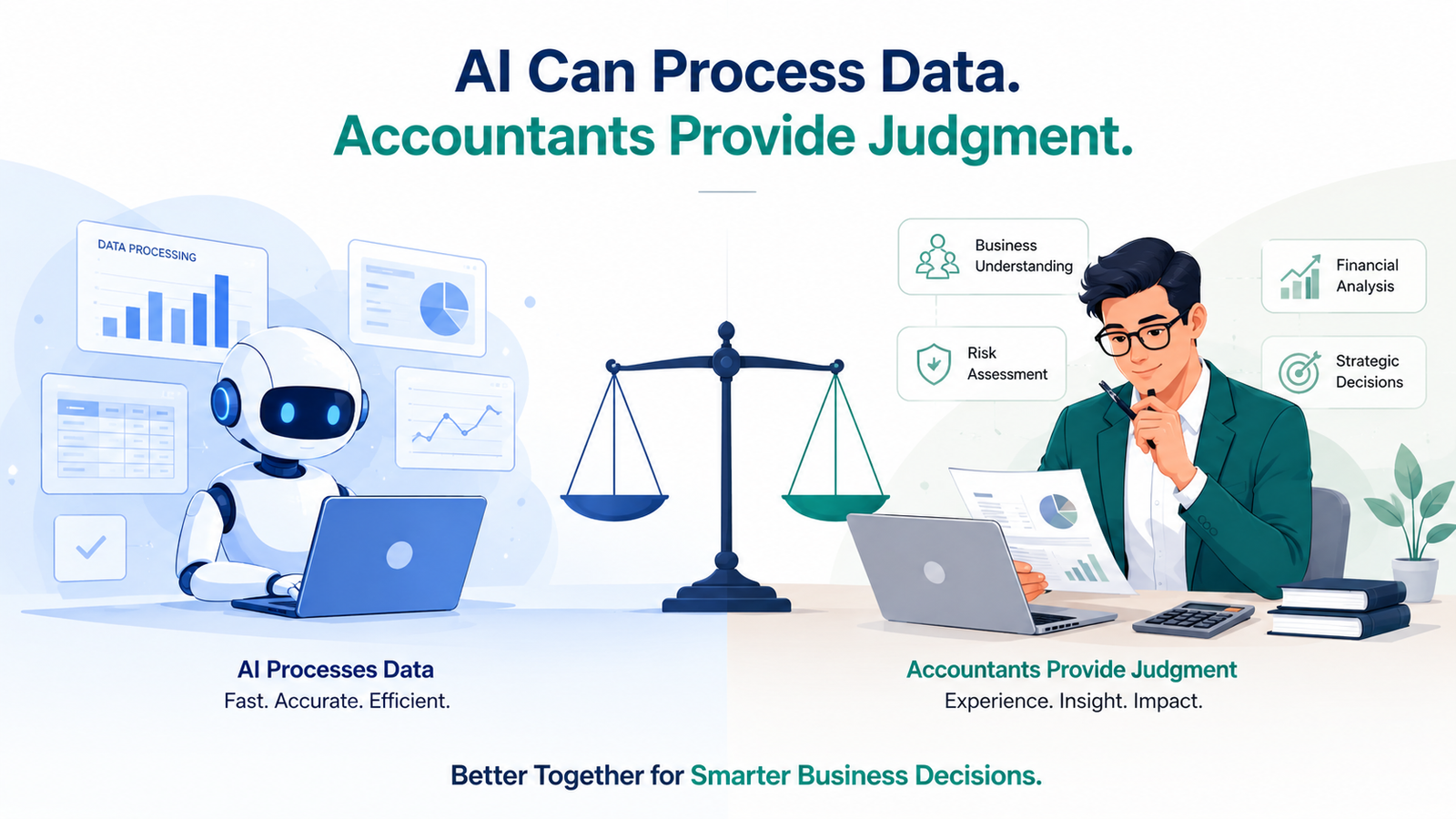
The digital landscape is evolving, and a fascinating harmony is unfolding – one where the precision of artificial intelligence (AI) is being complemented by the astute judgment of accountants.
This synergy between technology and human expertise is revolutionizing the field of accounting, enabling professionals to focus on higher-level tasks that require nuanced judgment and strategic decision-making.
By leveraging the strengths of both AI and human accountants, businesses can unlock new levels of efficiency, accuracy, and insight, ultimately driving better financial outcomes.
Automating Routine Accounting Tasks With AI Technology Increases Efficiency
Automating routine accounting tasks with AI technology is a game-changer for businesses, enabling them to streamline their financial processes and reduce manual errors.
AI-powered tools can process vast amounts of data at unprecedented speeds, uncovering hidden insights and patterns.
Machine learning algorithms can identify and prevent fraudulent activities, reducing financial risks and protecting business assets.
By automating routine tasks, accountants can now focus on high-value services such as financial planning, analysis, and consulting.
AI Support Enables Accountants To Focus On Higher-Value Client Services
With the help of AI support, accountants can streamline routine tasks, such as bookkeeping and compliance, and allocate more time to strategic advisory services.
AI can help identify areas of opportunity, provide data-driven insights, and enhance overall service delivery.
By leveraging AI, accountants can scale their practice, improve efficiency, and increase client satisfaction.
Benefits Of Implementing AI In Accounting Firms Include Enhanced Productivity
A notable example of AI implementation in accounting is the case of a Singapore-based firm that automated its bookkeeping process using machine learning algorithms, resulting in a 30% reduction in manual errors and a 25% increase in processing speed.
The integration of AI in accounting firms can lead to enhanced productivity by automating routine tasks and enabling employees to focus on higher-value work.
The use of AI in accounting can also enable firms to provide more accurate and reliable financial services, such as audit and tax planning, by analyzing large datasets and identifying potential risks and opportunities.
Harnessing AI Capabilities To Improve Financial Reporting And Analysis Quality
The integration of Artificial Intelligence (AI) in financial reporting and analysis is akin to adding a high-octane fuel to a finely-tuned engine, significantly boosting its performance and efficiency.
By leveraging AI’s capabilities, financial professionals can automate mundane and time-consuming tasks, such as data entry and reconciliation, freeing up more time for strategic and high-value activities like financial modeling and forecasting.
AI-powered tools can also help improve the accuracy and reliability of financial reports by detecting and preventing errors, inconsistencies, and fraudulent activities.
Leveraging AI Tools To Enhance Auditing And Financial Statement Review Processes
Leveraging AI tools is crucial for enhancing auditing and financial statement review processes, as it enables companies to automate repetitive tasks, improve accuracy, and reduce costs.
By utilizing machine learning algorithms, AI tools can analyze large amounts of data, identify patterns, and detect anomalies that may indicate errors or fraudulent activities.
AI-powered tools can also facilitate the review of financial statements by identifying inconsistencies and providing real-time alerts.
The Role Of Human Expertise In Accounting When Using AI Generative Tools
Human expertise is crucial in accounting despite AI advancements.
Analyzing financial data to identify trends and anomalies is a key aspect of human expertise.
Creating customized accounting solutions for unique business needs is another area where human expertise is essential.
Overseeing AI-generated financial reports for accuracy and compliance is also a critical task that requires human expertise.
Navigating AI-Generated Errors And Risks In Accounting And Auditing Practices
The risk of errors and inaccuracies — such as misinterpretation of data or incorrect calculations — can have severe consequences: financial losses, reputational damage, and legal liabilities.
A delicate balance must be struck between leveraging AI’s benefits and mitigating its risks: implementing robust testing and validation protocols, for instance, can help ensure the accuracy and reliability of AI-generated data.
The use of AI in accounting and auditing is becoming more widespread — and as such it is crucial to develop strategies for navigating the associated risks and challenges — to ensure the integrity and accuracy of financial data.
Maximizing The Potential Of AI In Accounting To Drive Business Growth And Success
The notion that AI will replace human accountants is a misconception, as AI is designed to augment their capabilities, not supplant them.
In reality, AI can help accountants focus on higher-value tasks that require expertise and judgment.
By automating routine and repetitive tasks, AI can free up accountants to concentrate on more complex and strategic work.
Future-Proofing Accounting Careers By Developing Skills To Effectively Utilize AI
As the accounting profession continues to evolve with the increasing adoption of artificial intelligence (AI), it is essential for accounting professionals to develop skills that complement AI capabilities, such as critical thinking, problem-solving, and communication.
By doing so, accountants can focus on higher-level tasks that require human judgment, expertise, and empathy, while AI handles routine and repetitive tasks, thereby enhancing productivity and efficiency.
The key to future-proofing accounting careers lies in developing skills that complement AI capabilities.
As the evolving landscape of data processing and accounting continues to shape the future of finance, the symbiotic relationship between AI and human professionals will likely give rise to new and innovative solutions.
The dynamic interplay between AI-driven data analysis and human judgment will likely lead to more strategic and advisory services to clients.
Ultimately, the most effective solutions will be those that harness the unique strengths of both AI and human professionals.

Disclaimer: The information contained in this blog is for general information purposes only and is not intended as legal advice. While we endeavour to provide information that is as up-to-date as possible, Intime Accounting makes no warranties or representations of any kind, express or implied about the completeness, accuracy, reliability, suitability or availability with respect to the content on the blog for any purpose. Readers are encouraged to obtain formal, independent advice before making any decisions.